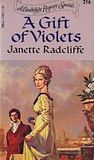
 A Gift of Violets by Janette Radcliffe
My rating: 3 of 5 stars on Goodreads
This is an altered version of my Goodreads review. It contains more details from the novel, so it may contain spoilers.
To be honest, I'm not exactly sure why I liked A Gift of Violets as well as I did. There are some copy-editing errors and some craft flaws, the most notable of the latter deal with characterization of the heroine, Viola Marchmont.
Viola feels too good to be true at times. Such as when she deeply cares about the hero's emotional scars, even after he pronounces his desire to avenge himself on her family. This doesn't change when the hero, Giorgio Michieli, decides his revenge will be marrying one of Sir Anthony Marchmont's daughters, which number three including Viola. And then, when Viola accepts Giorgio's proposal, her supposed reasons for acceptance are that "she had promised the Blessed Virgin she would do anything [. . .] to make up for what her father had done to this gentleman" (57). And then on the morning of wedding, which is a week after her acceptance, she has a similar line of thought as she prays: "She knelt before the Virgin and murmured her prayers over and over--that she might make Giorgio happy, and help him recover from the scars of his experiences For herself, she dared not even think" (72).
At other times, Viola is almost unnatural with how she gets over, never thinks on, or moves past emotional things. It takes her a long time after Giorgio's pronouncements and her father's reactions to actually begin to suspect her father. There is no excuse really early on during this time--no "oh, my father never could"--it just never comes up in her thoughts, and barely does throughout the novel. Then, despite suspecting it is mostly revenge inspiring Giorgio's proposal (though she hopes it might be something more), she believes he will protect her and do right by her. And throughout this early part of the novel, while Giorgio announces his intention of extracting his due out of Sir Anthony and later when is deciding between the three daughters, none this stays long in Viola's mind. For example, after Giorgio leaves after his first confrontation, Viola is feeling sorry for Giorgio: "The scar on his face was echoed by deeper scars on his mind and his soul. She was busy then until luncheon" (13). It is not until the end of the chapter she thinks again on Giorgio, but in an odd way. Mostly she wonders what price will alleviate his suffering, wants to be there when he returns, wishes she had said something soothing, and feels sympathy for Giorgio (16). Not things I would be thinking on when someone like Giorgio makes accusations and demands upon my father!
Especially in the beginning, I saw these flaws. Normally flaws such as these push my rating down, but I either got more involved with the story as it progressed, or in some cases, the flaws just didn't seem as prevalent later on in the novel.
Yet despite these flaws, the novel drew me in. Maybe it is the hero, Giorgio, who reminds me a little of the new, TV version of Oliver Queen/Arrow. He has scars both mental and physical, and he has a tendency to not quite tell the whole truth even on the little things. I think Giorgio was definitely a draw.
But I think mostly the mystery and surprises kept me reading. Mysteries such as why did Giorgio choose Viola to marry (though, that was never quite answered satisfactorily for me), does he love Viola or not, what is the real story of his past (that ties into Viola's family), and why he is he so protective of Viola? In the beginning, you do kind of doubt Giorgio's love, because it takes a while for him to consummate the marriage (which is another reason why I like him). But it is not just that; he doesn't treat her as a wife, really, though he sees to her comfort. He also is very protective of her; though I guessed why--there are threats to Giorgio, so they may spill over onto Viola--we are not quite sure right away what these threats are. I suspect one thing, but am surprised to find out it is a little different, but it still works, it is still all tied in together. Finally, there is the question of Viola's father's role in Giorgio's past horrors: Giorgio was involved in secret missions; Sir Anthony knew of them; did Sir Anthony really betray Giorgio, purposefully or accidentally or not at all?
Later come the surprises, such as when we see that Giorgio has cause to protect Viola against some real threats and the consequences of those threats. There is a scene where Viola is leaving a concert at a Giorgio's friend's house. Giorgio has been called away, and we do wonder if it is to a mistress or some business. Anyway, as Viola leaves, she is attacked and stabbed--in a scene really rather well done! I never expected that, nor did I expect some other scenes later. These scenes were major draws for me.
And finally, despite the craft flaws concerning Viola's character, something about her is sympathetic, especially when you see her love grow for her husband even though she has doubts about it being requited. More and more you see her yearn for her husband and long for him to love her. She feels jealousy over a potential mistress, and she finally decides to take on her sisters' flirtatious airs, even though she it embarrasses her, in order to get Giorgio to think of her not as a child-like wife but as a woman he can feel longing for. Either way, I was rooting for her to get him to open up to her that way, and I was so glad that he did. And I enjoyed seeing how much he did love her, while seeing her through her recovery to finally consummating the marriage and to how he seemed so much softer and happier beyond that moment.
So overall, I did enjoy this story, enough to look for more of Janette Radcliffe's works in hopes of seeing perhaps fewer craft flaws and more surprises and mystery.
Cite: Radcliffe, Janette. A Gift of Violets. New York: Dell Publishing, 1977. Print.
Genre/Time Period: Regency
Search Categories: Florence, married couple, revenge, coerced proposal
Heat Level: mostly sweet, except for a little, non-graphic detail on the consummation scene
Rating: three stars

No comments:
Post a Comment