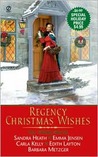
 Regency Christmas Wishes by Sandra Heath
My rating: 3 of 5 stars on Goodreads
This is a modified version of my Goodreads review. This contains more spoilers than my Goodreads review.
It is difficult to judge an anthology as a whole. It is made up of different works appealing to different readers, different works with different strengths and shortcomings. It is also difficult to judge romance in novella form. It just rarely works well; things go too fast to be believable. Finally, there is the theme, which makes makes the writer's job that much more difficult. I tried to keep all this in mind while reviewing this anthology.
In an anthology about Christmas, I want the tales to lift my spirits, make me laugh, or cause a sniffle. I don't want them to depress my spirits and force me to look at the dreary parts of human nature. "Following Yonder Star" (Emma Jensen) and "The Merry Magpie" (Sandra Heath) did this.
"The Merry Magpie" deals with infidelity of the husband. That alone is enough to turn me off the story. Perhaps one can argue Christmas at heart is about Christ, who espouses forgiveness, and thus this is truly a Christmas tale; but I'm afraid it is not a subject I want to read. Besides, one also must truly be repentant to be forgiven. Though the author tried to make the case for this, I just can't believe in someone who knows he is doing wrong, and who keeps doing wrong, is ever truly repentant, even if he stops because he is caught. One can make a case, as the author does, that immaturity is the root of the hero's infidelity; I rather think it is a part of his adventure-seeking nature, for he travelled the world after cast out of his wife's life. Anyway, I just found this tale's subject matter too depressing and disgusting--perhaps a full novel would have resolved the root problem of infidelity between the hero and heroine, but why would I want to read about a subject I hate?
"Following Yonder Star" is depressing for different reasons, and I see very little of the Christmas spirit in it. Instead, I see the chore that Christmas has become for many people. But beyond that, the characters are depressing. The hero is a little like the hero in "The Merry Magpie"--he is adventure-seeking to the point of hurting others. Though this changes at the end, I doubt it will keep. Concerning the heroine, the author repeatedly shows us how ill-used the heroine is by her selfish sister,and how she keeps putting up with it. All the characters complain a lot, and none of them really engage my sympathy. Overall, the tone is dispiriting.
To me, these two tales are not in keeping with the Christmas spirit. That being said, they are not without merit. The magpie was interesting and done well, and Jensen can write well. I would like to see what these two authors can do in a different work, Jensen especially.
Neither depressing nor uplifting is "Best Wishes" by Edith Layton. The characters start off annoying--one in a tantrum, one cold--but the characters, like the work, improve as the tale goes on. And the tale does have good traits, tying into the setting; I like how it touches on real life holiday problems (dealing with in-laws). In fact, I even feel for the hero a little because I understand the torture of being brought to a party and then left to one's own devices, while the bringer goes off and mingles happily but the odd-duck is stuck twiddling thumbs until the party is over. But like the previous two heroes, he was a bit of a rake, and it takes a bit for me to look past a rake, even a former one. Focusing on his sexuality is not the way to do this. Finally, I like my stories sweeter than sensual, and this one while not explicit, was a little too sensual for me, especially in a Christmas setting.
Carla Kelly's "Let Nothing You Dismay" and Barbara Metzger's "The Lucky Coin" are the best works, with the latter being the very best. Metzger's had the most to do with the theme of the anthology (wishes and Christmas). She is an author I have come to rely upon for great writing and great story, and she does not disappoint in "The Lucky Coin." This tale contained her characteristic surprising (and humorous) twists, delightful characters, great voice, and even dogs. The only drawback is I didn't quite believe in the quickness of the hero and heroine's love, but that is a fault of the form (or length), not the author. Even Kelly's suffers from this problem.
Overall, Kelly's tale "Let Nothing You Dismay" works well, and she uses Christmas as a suitable backdrop. I like how she used it as a way for family to reconnect, which is often one thing Christmas is about for many families. More than that, though, her style and characters reminded me of Metzger's. However, she lacks the humorous surprises and twists of Metzger; this is only a shortcoming when comparing the two authors, not when judging each author on her own merits. However, I felt the story's characters suffer from a lack of steadiness--the hero's emotions start out very dark, are forgotten for the most part, then return as dark toward the end. Compounding that problem is melodrama during the climax, as he gets over his dark moment. I suspect the melodrama owes to the form, again, but I cannot say that without reading more. And I do intend to read more of Kelly.
So for better or worse, my verdict is two stories I didn't care for, one story that was so-so, one I liked, and one I really liked. Because of Kelly and Metzger, I rated this anthology three stars.
Genre/Time Period: Regency
Search Categories: Christmas, anthology, wishes, infidelity, luck
Heat Level: sweet, except for one is a little sensual
Rating: three stars

No comments:
Post a Comment